
So there you are, hot on the trails of 2026’s planning and goal setting. You ask yourself, “Is SEO still worth investing in 2026 with all this AI disruption? Should I optimize for AI search?”
The short answer is YES! And here’s why…
Is SEO Still Worth It in 2026?
A Realistic Look at What’s Changed and What Hasn’t
While I’m all for ethical and responsible Ai use, there is a tremendous amount of hype in the industry around AI to be true. Some of these emerging areas have no doubt affected how SEO is observed today, but many of the fundamentals remain the same.
Forward-thinking brands are moving cautiously, because the fundamentals of SEO done well are far too valuable to simply abandon in pursuit of the latest trends. That being said, the market share for AI search is growing, so one would be foolish to ignore it entirely. The good news is, traditional SEO overlaps very well with AI SEO (GEO/AEO or whatever you want to label it as). But there are some key differences about AI search to know about and plan for.
For me, SEO has always been the art in the pursuit of targeting the right buyer intent over rankings and vanity metrics. Staying curious in the pursuit of where your target audience might be doing searches to solve their problems now, and in the future. Traditional SEO has long been synonymous with Google, but a diversified SEO strategy builds multi-million dollar brands… this is something that best demand generation marketers know quite well.
My recommendation is not to drop what you’re doing and focus solely on LLM optimization alone. Continue to sustainably build on your core fundamentals like; content development, repurposing, and distribution to expand your reach. With all that in mind, here are a few things I’m thinking about with the current state of SEO in 2026.
The Great Decoupling:
When Impressions and Clicks Stopped Moving Together
If you’ve been watching your Google Search Console data over the past year, you’ve likely noticed something unsettling. Impressions trending upward while clicks trend downward, or at best, stay flat. The industry started calling this “The Great Decoupling,” and it’s one of the clearest signals that search behavior has fundamentally changed.
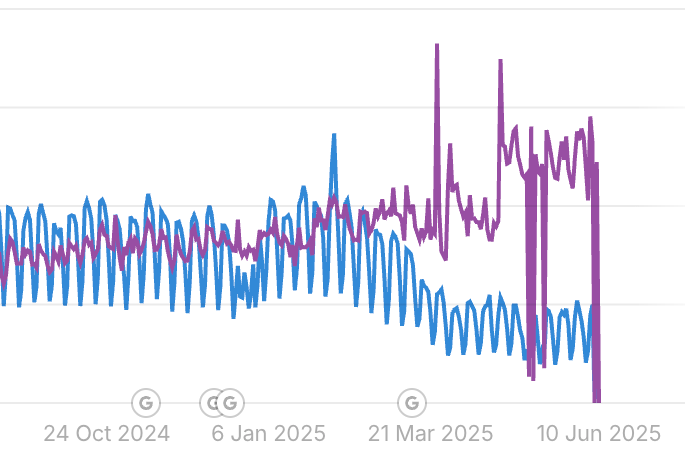
The pattern became unmistakable when AI Overviews started rolling out broadly in early 2025. Users ask a question, Google synthesizes an answer from multiple sources directly in the results, and the user gets what they need without ever clicking through to a website. Your content might be powering that answer, but you’re not seeing the traffic. Seer Interactive’s September 2025 study found that organic CTR plummeted 61% for queries where AI Overviews appeared. Paid CTR fared even worse, dropping 68%.
But here’s where it gets even more interesting. Throughout early 2025, many SEOs noticed what some called the “Alligator Effect” in their Search Console charts, a visual pattern where rising impressions and flat clicks created an open alligator mouth shape in the data. The assumption was that AI Overviews were causing all of it.
Then September 2025 happened, and that alligator snapped shut.
Google’s Quiet War on Scrapers
Around September 10-14, 2025, Google quietly deprecated the &num=100 URL parameter. For years, this simple URL hack let SEO tools and rank trackers pull 100 search results in a single request instead of the default 10. Every major rank tracking platform, Semrush, Ahrefs, Moz, and countless others, built their data collection infrastructure around this parameter.
Google didn’t announce the change. No blog post, no developer documentation update. They just turned it off.
The fallout was immediate and industry-wide. Many sites saw impression declines in Google Search Console, and many lost unique ranking terms in their discovery reports. SEO tool providers suddenly needed to make 10 separate API calls to gather what previously required one, multiplying infrastructure costs by a factor of ten overnight.
But here’s the uncomfortable truth that emerged: much of that impression data was never real in the first place.
When automated tools scraped 100 results at once, every URL on that page registered an “impression” in Search Console, even if it was sitting at position 75 where no human user would ever scroll. Those weren’t real impressions from real people. They were artifacts of bot traffic that had been inflating our metrics for years. The September drop wasn’t a decline in performance. It was a correction toward honest data.
What This Means for How We Measure SEO
The &num=100 removal forced the SEO industry to confront something we’d been avoiding. Our measurement systems were partially built on sand. When Google’s Danny Sullivan was asked about the change, his response was telling: the parameter was “not an officially supported feature.” We’d been relying on an undocumented hack that Google tolerated until they didn’t.
The theories about why Google made this change range from combating AI scraping (LLMs were using these tools to harvest training data) to simple infrastructure efficiency. Whatever the reason, the result is cleaner data that actually reflects human behavior.
If your clicks and conversions stayed stable through September while your impressions dropped, congratulations. You now have a more accurate picture of your actual visibility. If both dropped, that’s a different conversation, but at least now you’re working with real numbers.
This is why I keep emphasizing that smart SEO has always been about more than just rankings and impressions. It’s about understanding where your actual customers are searching and whether you’re capturing that demand. The tools we use to measure that are only as good as the data feeding them, and 2025 taught us that some of our data was never as reliable as we thought.
Pay to Play with LLM Ads and Sponsored Content
The advent of sponsored ads for LLM platforms is here. We know ads for AI mode are coming in Google and ChatGPT. It’s not a matter of “if”, but “when”. Just have a look at some of these resources:
- Google Ads Begin Surfacing Inside AI Mode (Search Engine Land, Nov 2025)
- Google Brings Ads to AI Mode (TechCrunch, May 2025)
- OpenAI’s ChatGPT Ads May Prioritize Sponsored Content (Search Engine Roundtable, Dec 2025)
- About Ads in AI Overviews (Google Ads Help)
As of late 2025, Google has been actively testing ads embedded directly in AI Mode responses, labeled as “Sponsored” content blending with AI-generated answers. OpenAI is following suit, with reports of staff discussing ways to give sponsored content “preferential treatment” in ChatGPT responses. The implication here is significant: if you’re banking your entire strategy on organic visibility within LLM platforms, you may soon find that visibility commoditized through paid placement, just like what happened with traditional search over the past two decades.
Smart brands with a diversified SEO strategy that positions them as the topical authority through content production and who are mindful of keeping an eye on how their target buyers adopt new ways of searching will win long-term. As Google said this year, consistency is key. An SEO strategy based on First-Party data sources like Google Search Console for established brands, and Third-Party research methods like keyword planner and best-in-class industry tools can help understand where there is demand. While no one tool is created equal, getting views from multiple angles can be helpful to paint a clearer picture of how to authentically tackle your own industry’s needs.
I’m not sure how transparent the reporting of these emerging advertising platforms will be, but it has the potential to help marketers collect audience insights faster through the data they earn there experimenting.
How Search Results Have Changed Over Time
If you’ve been doing SEO for any length of time like I have, you’ve noticed the SERP (Search Engine Results Page) of 2026 looks nothing like what we were optimizing for even five years ago. The ten blue links that once dominated our strategy meetings have given way to a complex ecosystem of features, panels, and AI-generated summaries that fundamentally change how users interact with search.
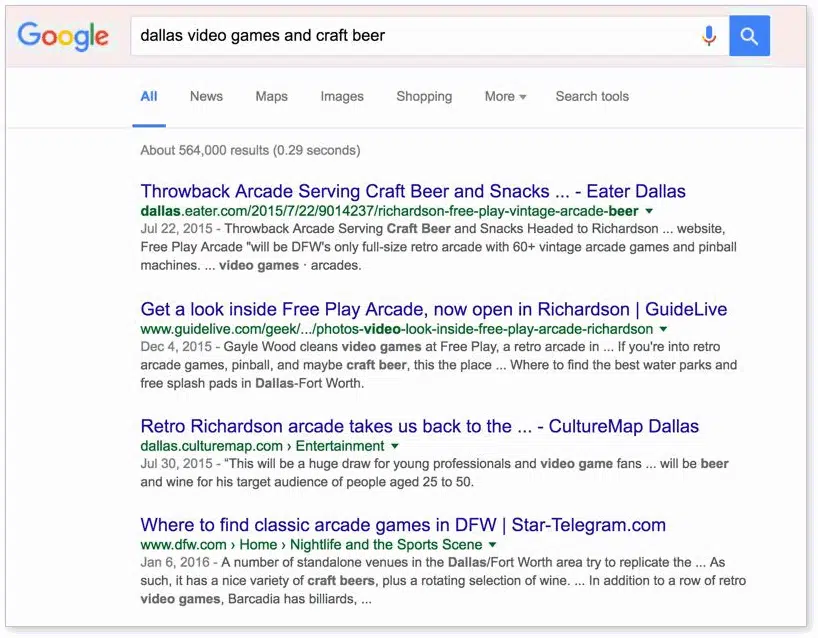
The evolution has been gradual but relentless. Featured snippets came first, pulling content directly into the results page. Then came People Also Ask boxes, knowledge panels, local packs, video carousels, and shopping results. Each new feature represented Google extracting more value from publisher content while keeping users on Google’s property longer.
But the real disruption started when generative AI entered the picture. Suddenly, we weren’t just competing for position on a list. We were competing for inclusion in an AI-synthesized answer that might never send a click to our site at all.
AI Overviews
AI Overviews represent Google’s attempt to synthesize information directly within search results. When triggered, they appear prominently above traditional organic results, providing users with AI-generated summaries drawn from multiple sources across the web.
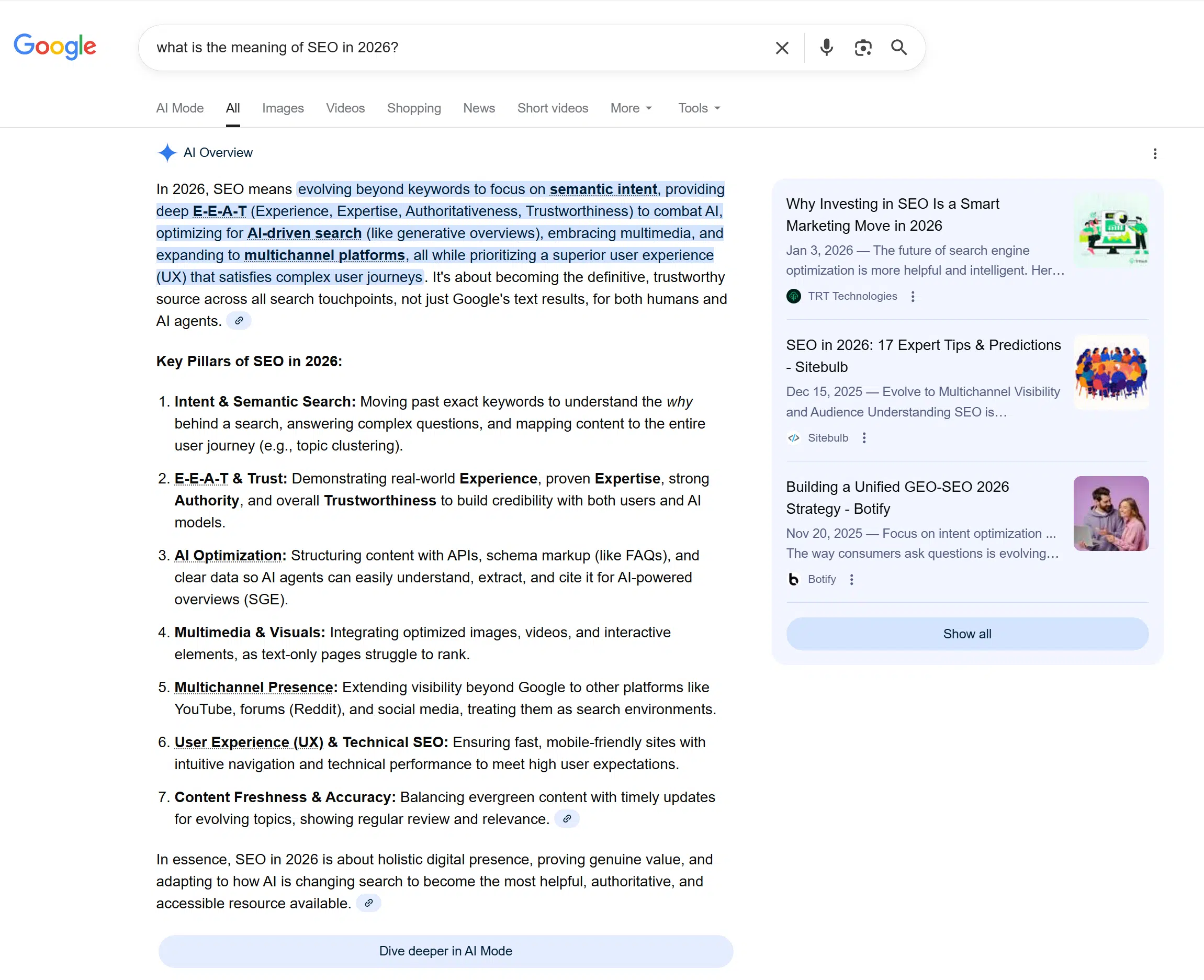
For SEO practitioners, this presents a double-edged sword. On one hand, being cited as a source within an AI Overview can provide significant visibility and brand exposure. On the other, that visibility doesn’t always translate to clicks. Users get their answer without ever visiting your site. Industry data suggests informational queries are seeing significant declines in organic clicks once AI Overviews are triggered, with some analyses showing 18-64% reductions depending on query type.
The good news? AI Overviews don’t trigger on every query. Commercial-intent and transactional searches still often display traditional results but that could change. Another key observations is that the sources cited in AI Overviews tend to be authoritative, well-structured content that already performs well in organic search or is user-generated (UGC) content like Reddit. In other words, good SEO fundamentals still matter, perhaps more than ever.
AI Platforms
Beyond Google’s AI Overviews, we’re now seeing legitimate search behavior on standalone LLM platforms like ChatGPT, Perplexity, Claude, and Gemini. These platforms aren’t search engines in the traditional sense, they’re conversational interfaces that can access real-time information and make recommendations. Each platform has begun launching their own browsers and browser extensions, further diversifying the ways you can be found.
ChatGPT alone reports hundreds of millions of weekly active users. Perplexity, built specifically as an AI-powered search tool, has seen explosive growth with visits increasing over 600% year-over-year. These aren’t experimental toys anymore. Real people are using them to research products, compare services, and make purchasing decisions.
The challenge for SEO professionals is that these platforms operate differently than Google. They pull from their training data, real-time web access, and their own proprietary ranking signals. Being mentioned in ChatGPT’s response isn’t the same as ranking #1 on Google, and the optimization strategies aren’t identical either.
What we do know is that content structure, brand authority, and being present across authoritative sources on the web all seem to influence whether and how LLM platforms reference your brand. This isn’t a departure from SEO fundamentals, it’s an extension of them.
Pitfalls and Snake Oil Rampant in AI SEO, GEO, AEO Tools
Here’s where I need to be direct with you: there’s a lot of noise in this space, and not all of it is honest.

The gold rush to capitalize on AI SEO, GEO (Generative Engine Optimization), and AEO (Answer Engine Optimization) has spawned an entire cottage industry of tools making promises they simply cannot keep. Before you invest in the next shiny platform promising to track your “AI search visibility,” let’s talk about the fundamental limitations of tracking as it stands today.
The methodology behind these tools varies wildly, and that matters. There are two primary approaches vendors use to track AI visibility that you need to know about. UI scraping (bots that crawl LLM interfaces and extract responses) and API-based monitoring (using official platform APIs to submit queries and capture structured data).
Conductor’s analysis of these methods highlights significant differences. Scraping is fragile with frequent need for UI updates, anti-bot defenses, and authentication changes that can silently break data collection without warning. It also typically violates platform Terms of Service.
API-based monitoring provides more structured, auditable data, but here’s the catch that even proponents of API methods acknowledge: scrapers capture only “one narrow user configuration,” while real users span multiple devices, settings, plugins, and conversation histories. API methods face similar constraints. Neither approach can truly replicate the diversity of actual user experiences across LLM platforms. The fundamental measurement problem remains unsolved regardless of which method a vendor uses. That doesn’t mean you shouldn’t explore using them, but I wouldn’t use them as the ultimate source of truth. But rather, it can be used as another point of data you can add to the aggregate information that strengthens the direction of your strategy.
Synthesized queries don’t tell the true story. Many tools claiming to track your visibility in LLM platforms are running synthesized queries, essentially asking ChatGPT or Claude the same question repeatedly and logging whether your brand appears. The problem? That’s not how real users interact with these platforms. A single prompt can be phrased a thousand different ways, each yielding different results. The synthesized data these tools provide creates a false sense of measurability where none truly exists.
High customization exists across LLM platforms making it challenging to actually quantify what’s really happening. Users configure their LLM experiences with background system parameters, custom instructions, memory settings, and conversation history. The ChatGPT response I see is fundamentally different from the one you see, because the platform has learned our individual preferences. Any tool claiming to show you “your visibility” is showing you a synthetic version that may have zero correlation with what your actual target audience experiences.
Consistency in results is often a factor when conducting back-to-back searches in LLM platforms. Ask the same question twice in a row on ChatGPT and you may get notably different answers, with different sources cited. This isn’t a bug, it’s how probabilistic AI models work. Building an entire optimization strategy on data that changes with each query is building on sand.
The honest reality is that we’re in the early innings of understanding how to optimize for AI-driven search. Anyone claiming to have it all figured out is either misinformed or selling you something. The fundamentals, authoritative content, strong brand presence, technical accessibility, and genuine expertise, still matter most. Everything else is iteration and experimentation.
At the end of the day, the most helpful thing you can do for your business is audit what LLMs are saying about your brand and determine whether that is accurate. Where out-of-date content on your website may not show on Google, it could still be cited by LLMs and throw a potential buyer off.
So, Is SEO Worth It?
After everything I’ve laid out here, you might expect me to say SEO is dying. I won’t, because it’s the opposite.
What’s been dying for a long time is lazy SEO. The keyword-stuffing, link-farming, thin-content-producing approach that some agencies still try to pass off as strategy. AI is accelerating the death of that approach because these platforms are trained to recognize and reward genuine expertise over gaming tactics in a listicle style format we’re accustomed to from traditional Google rankings.
What remains valuable, perhaps more valuable than ever, is understanding how your target audience searches for solutions to their problems, wherever that search happens. That might be Google. It might be ChatGPT. It might be asking Claude for a recommendation. The brands that win are the ones positioned to be found and trusted in all of those contexts.
A diversified search strategy in 2026 means:
- Maintaining strong organic visibility in traditional search where the bulk of search behavior still lives
- Creating content that positions your brand as the authoritative answer to your industry’s questions
- Ensuring your website is technically accessible to the crawlers that feed LLM training data
- Tracking what you can measure while acknowledging the limitations in this new landscape
- Staying curious about where your target buyers are actually searching, not just where you wish they were
SEO isn’t dead. It’s evolving. The practitioners who evolve with it will thrive. The ones clinging to 2015 playbooks, or chasing snake oil AI tools, won’t.
You can’t control the weather, but you can grab a surf board to enjoy the waves.