
AI Overviews, featured snippets, and knowledge panels are eating your clicks. Here’s how to win anyway.
I’m going to start with the uncomfortable truth most SEOs are dancing around: your organic click-through rates are declining, and they’re probably never coming back.
Look at your Google Search Console data from the past year. I’ll wait.
You’re likely seeing impressions climb while clicks stay flat or decline. The Great Decoupling, and it’s not a temporary blip or seasonal anomaly. It’s the new reality of search, and it’s only accelerating with AI Overviews rolling out across more queries every week.
The Problem: Google is answering more questions directly on the search results page, keeping users from ever clicking through to your website. But what most people miss is that this doesn’t mean you’re losing. It means you need to redefine what winning looks like.
This Isn’t Just About AI Overviews
Now before you panic about AI, Google has been training users not to click for years. Featured snippets launched in 2014. Knowledge panels have been around since 2012. People Also Ask boxes, local packs, shopping carousels… all of these exist to answer queries without requiring a click.
AI Overviews are just the latest evolution. They’re more sophisticated, they answer more complex queries, and they’re appearing on more search results pages. This… no doubt, has people questioning the current state of SEO. But the fundamental shift happened years ago when Google decided it was more valuable to keep users on their platform than to send them to your website.
Most SEOs responded in one of two ways: panic about declining traffic, or pretend nothing changed and keep chasing rankings like it’s 2015. Neither approach helps clients understand what’s happening or how to adapt to win.
The Two Battlegrounds You Need to Know
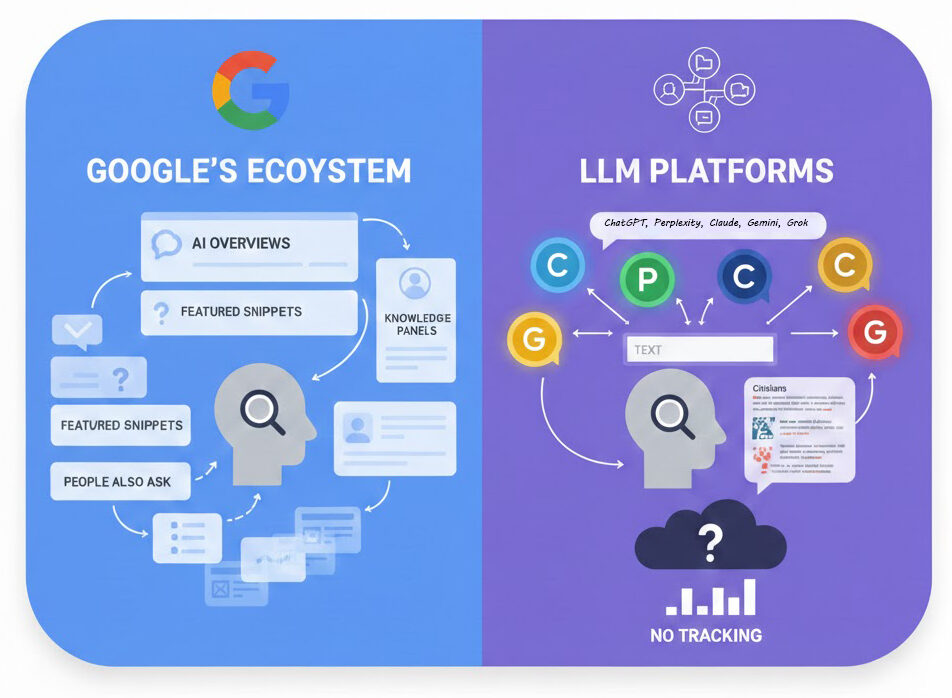
When I talk about zero-click SEO, I’m talking about two distinct battlegrounds where your brand needs to show up. They require different strategies but share similar fundamental principles.
Google’s Ecosystem
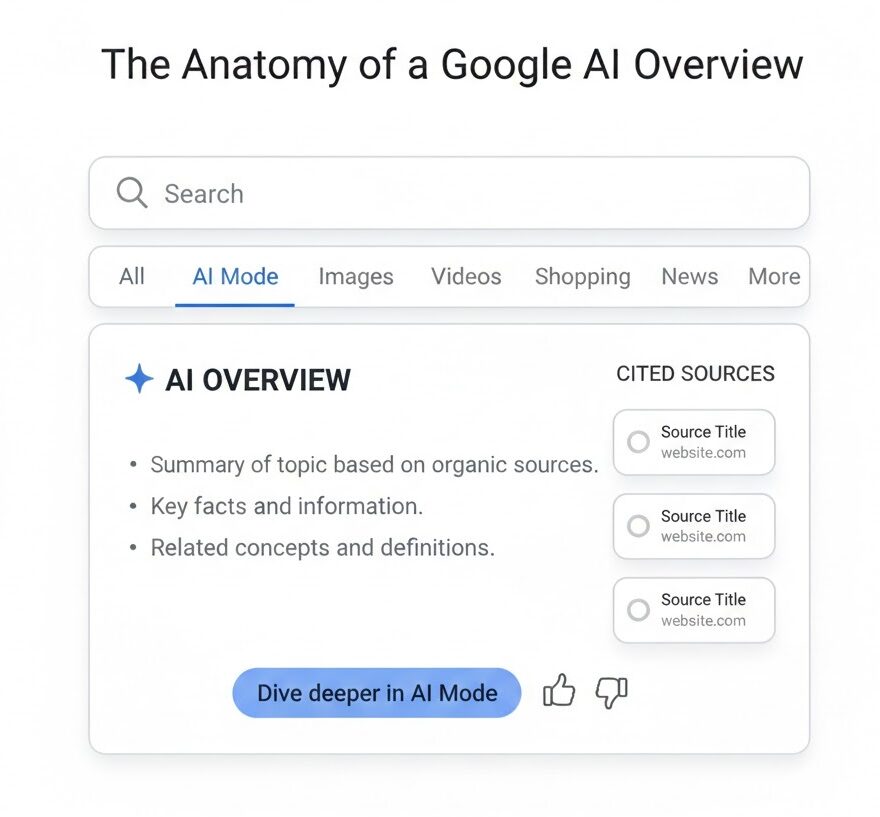
Most people are already losing clicks here. Google AI Overviews sit at the top of search results, synthesizing information from multiple sources and presenting it in a conversational format. Featured snippets grab the spotlight for question-based queries. Knowledge panels own the right rail for entity searches. People Also Ask boxes expand to answer related questions without requiring another search.
Every one of these features is designed to answer the user’s query without sending them to your website. The thing is, they still need to pull that information from somewhere, and that somewhere could be your content.
LLM Platforms
This is the emerging battleground that most businesses haven’t even started thinking about yet. ChatGPT, Perplexity, Claude, Gemini, and Grok are all being used as search engines now. Users ask questions, get detailed answers, and those answers include citations and recommendations.
If your brand isn’t being cited or recommended in these LLM platforms, you’re invisible to a growing segment of your potential audience. And unlike Google, where you can track impressions and clicks, most businesses have no idea whether they’re showing up in LLM responses at all.
Optimize for Citations, Not Just Traffic
When your content gets cited in an AI Overview or featured snippet, your brand gets exposure to everyone who sees that search result. Not just the people who click. That’s a fundamental shift in how we think about SEO value from the old days of just clicks.
Traditional SEO focused on rankings because rankings correlated with traffic, and traffic correlated with conversions. In zero-click search, the correlation breaks down. You can have massive visibility with minimal clicks, but that visibility still drives business outcomes through brand awareness and authority building.
To optimize for citation, you need to structure your content so AI systems can easily extract and attribute information. Write clear, quotable statements that directly answer specific questions. Use structured data to help search engines understand the relationships between entities in your content. Organize information in formats that AI can easily parse and present.
Entity-based content structure is critical. Instead of writing generic blog posts about broad topics, focus on establishing your brand as an authoritative entity associated with specific concepts in your industry. When AI systems build their knowledge graphs and determine what sources to cite, they’re looking for signals of authority and expertise, not just keyword optimization.
Why Citations Matter For Your Brand
When your brand is consistently cited as the source in AI Overviews and featured snippets, you’re building authority that compounds over time. Users may not click immediately, but they’re seeing your brand name associated with authoritative answers. That recognition drives brand searches, direct traffic, and higher conversion rates when users do eventually visit your site.
Multi-Touch Attribution Reality
Most SEOs see declining click-through rates and assume they’re losing business value. But that assumes conversions happen in a single session with a direct attribution path. That’s not how B2B buying works, and it’s not how most B2C buying works either.
When your brand appears in an AI Overview or gets cited in a ChatGPT response, users don’t immediately click through and convert. Instead, they remember your brand name. Later (maybe hours, maybe days) they search for your brand directly. Or they type your URL into their browser. Or they see your ad and click because they recognize you.
Multi-touch attribution is playing out in real time, and if you’re only measuring organic clicks, you’re missing the entire picture. While hitting the attribution Zen of ‘measuring all things’ isn’t really possible (we can dream), it’s important to know those discrepancies are happening.
I track several metrics to understand the full impact of zero-click visibility. Brand search volume is the most obvious indicator. When you start appearing consistently in AI Overviews for industry queries, you should see an uptick in branded searches. Direct traffic is another signal, though it’s messier to attribute. Google Analytics 4’s attribution modeling can help connect the dots, showing how organic impressions influence conversions that happen through other channels.
The businesses that understand zero-click are shifting their measurement frameworks. They’re looking at assisted conversions, analyzing how organic visibility influences the entire customer journey, and adjusting their ROI calculations accordingly. They’re not abandoning click-through rates as a metric, but they’re contextualizing them within a broader view of how search visibility drives business outcomes.
Content Architecture for AI Consumption
 Technical SEO meets the emerging world of AI search here. The fundamentals still matter. Your site needs to be crawlable, your content needs to be accessible, your internal linking needs to make sense. But there are additional considerations when you’re optimizing for AI consumption.
AI systems don’t just crawl your pages and extract keywords. They’re trying to understand the relationships between entities, the context around information, and the authoritative signals that indicate whether your content should be trusted. Your content architecture needs to do more than satisfy traditional SEO best practices.
Structured data implementation goes beyond basic Schema.org markup. You need to think about how you’re defining entities on your site, how you’re establishing relationships between pieces of content, and how you’re signaling expertise and authority in ways that AI systems can parse.
Content depth versus breadth becomes a strategic decision. AI systems value comprehensive, authoritative content that thoroughly addresses a topic. But they also need to understand how different topics relate to each other and where your expertise lies. Balance in-depth pillar content with supporting articles that establish semantic relationships.
FAQ sections are particularly valuable because they map directly to how people ask questions in both traditional search and LLM platforms. But they need to be substantial. Real answers to real questions, not thin content stuffed with keywords. AI systems can tell the difference, and they’re getting better at it every day.
Opportunity: As more users discover they can use longform searches and get answers right in Google, keep an eye out for long-tail queries in Google Search Console you can mine for audience intelligence! Knowing what to write is just as valuable as knowing how to optimize. Pages may be showing up partially for searches you can better address with unique pages exclusively on that topic.
The Brand Authority Play
Sometimes the goal isn’t to capture the click immediately. It’s to establish authority that pays dividends over time.
CFOs get uncomfortable with this strategy because it’s hard to measure in traditional terms. But it’s also the strategy that creates sustainable competitive advantages in AI-powered search.
When your brand is consistently cited as the authoritative source in AI answers across your industry, you’re not just capturing individual conversions. You’re building brand equity that influences every stage of the customer journey. Users who see your brand name repeatedly in AI Overviews and LLM citations develop an association between your brand and expertise, even if they’ve never visited your website.
This authority compounds over time in ways that traditional SEO doesn’t. Rankings fluctuate based on algorithm updates. Traffic varies with seasonality and competition. But brand authority, once established, becomes increasingly difficult for competitors to displace.
The businesses winning at this are investing in genuinely authoritative content: original research, detailed technical documentation, comprehensive Youtube video guides that establish them as domain experts. They’re not chasing quick wins or gaming algorithms. They’re building resources that AI systems recognize as valuable sources worth citing.
You won’t see immediate ROI in your organic traffic numbers with this approach. But over six months, a year, two years, you’ll see your brand mentioned in conversations you’re not part of, recommended by AI systems you don’t directly interact with, and recognized by prospects who’ve never clicked on your website but already know who you are.
What to Measure
I’m going to give you the metrics that matter for zero-click SEO, but first, a warning: your boss is probably still asking for rankings and traffic numbers. Don’t abandon those metrics entirely, but add context around what they mean now.

Brand search volume is your primary indicator of whether zero-click exposure is working. Track branded searches month over month, looking for correlation between increased visibility in AI features and upticks in brand queries. It’s the most direct signal that people are seeing your brand in zero-click contexts and remembering it.
AI Overview appearance frequency matters if you can track it. It’s harder than traditional ranking tracking because AI Overviews don’t appear consistently, and you can’t always predict which queries will trigger them. But tools are emerging to help monitor this, and it’s worth investing in tracking how often your brand is cited when AI Overviews do appear.
Direct traffic correlation is messier but still valuable. Compare your direct traffic trends against periods of increased Ai overviews in SERP feature visibility. While direct traffic includes noise from multiple sources, meaningful spikes that correlate with visibility increases can indicate people are remembering your brand and returning directly.
Assisted conversions in Google Analytics 4 help connect the dots between organic impressions and conversions through other channels. Look at your attribution reports to understand how organic search influences the customer journey even when it’s not the last click before conversion.
For impressions and SERP features, you need to recontextualize what these metrics mean. Impressions are more valuable than they used to be because each impression includes potential exposure in AI features, featured snippets, and knowledge panels. Track which SERP features you’re winning, not just which keywords you rank for.
The business metrics that matter are pipeline influence, deal velocity for known brands, and cost per acquisition across all channels. If your zero-click strategy is working, you should see deals close faster when prospects already recognize your brand, and your overall customer acquisition costs should improve as organic visibility reduces reliance on paid channels.
The Budget Reality
Zero-click SEO requires investment in content quality, technical infrastructure, and analytics capabilities. You can’t cheap out on content and expect AI systems to cite you as an authority. You can’t ignore technical SEO and expect crawlers to properly index your content. You can’t skip proper measurement and expect to prove ROI.
For directors of marketing and demand gen managers reading this, your budget reality looks like this: you need resources for content development that goes beyond keyword-optimized blog posts. You need technical expertise to implement structured data and optimize for AI consumption. You need analytics infrastructure that tracks multi-touch attribution and brand influence beyond last-click conversions.
The ROI calculation shifts from cost per click to cost per brand impression and influence on pipeline. The finance conversation gets harder because you’re not showing a direct line from spend to revenue. But the alternative (ignoring zero-click search while your competitors establish authority) costs more in the long run through lost visibility and diminished brand recognition.
Many businesses can’t afford not to invest here. They’re already losing clicks they don’t realize they had. They’re invisible in LLM platforms that an increasing segment of their audience uses daily. They’re ceding authority to competitors who recognized this shift earlier and invested accordingly.
Investment Priorities: Start with content quality and entity establishment. Get your structured data in order. Implement proper measurement frameworks. Then scale up based on what’s working. It’s not about spending more. It’s about spending strategically on capabilities that matter in AI-powered search.
What This Means for Your Business
Not every business needs to go all-in on zero-click optimization immediately. Your priorities depend on where you are and where your audience is. For some, it’s about understanding how to adapt where clicks have been lost.
If your target audience is early adopters who use AI search tools heavily, prioritizing LLM platform optimization makes sense. If you’re in a highly competitive space where Google’s AI Overviews dominate your key queries, focusing on citation optimization for Google’s ecosystem is critical. If you’re a smaller player trying to build authority against established competitors, the long-term brand authority play might be your best path forward.
For pitching this internally to executives, frame it around competitive positioning and customer journey influence rather than just SEO tactics. Show them what happens when prospects encounter your brand repeatedly in AI answers before they ever visit your website. Demonstrate how this visibility influences deal velocity and conversion rates downstream.
Resource allocation between battlegrounds requires testing and iteration. Start tracking where your audience searches, even if you have to ask them. Are they using ChatGPT for research? Are they starting with Google and encountering AI Overviews? Are they using Perplexity for specific queries? Your optimization priorities should match where your prospects are.
Timeline expectations are crucial to set upfront: this is not a quick win. Building the authority and citation frequency that drives meaningful results takes months, not weeks. But the compounding effects are worth the patience. Early movers who establish authority now will be increasingly difficult to displace as AI search matures.
The Opportunity Most Brands Are Missing
What frustrates me about the industry reaction to AI-powered search: most brands are either ignoring it entirely or panicking without a strategy. Both responses miss the opportunity.
Right now, we’re in the early stages of a fundamental shift in how people search for information. AI Overviews are rolling out, but they’re not everywhere yet. LLM platforms are gaining adoption, but many businesses still don’t know they exist. The brands that recognize this shift and adapt now have a window to establish authority before the space gets crowded.
Your competitors are probably not optimizing for this yet. They’re still focused on traditional rankings and traffic metrics. They’re not thinking about LLM citations or multi-touch attribution from zero-click exposure. You have an opportunity to build authority and visibility that will be much harder to achieve once everyone catches up. But it’s really important to lead that decision with any insights you can muster on whether your target audience uses Ai and their sentiment to it. For many smaller businesses doing as much work as possible that overlaps heavily with traditional SEO with often be enough to get LLM placement.
I’m not fear-mongering about AI disruption. I’m not telling you to panic or completely abandon traditional SEO. I’m recognizing where attention lives and helping you adapt to meet your audience where they are. Some of that attention is still on traditional search results pages. But an increasing amount is happening in zero-click contexts, and you need a strategy for both.
The brands that succeed in AI-powered search will shift their mindset from “capturing the click” to “building authority wherever people search.” They’ll invest in genuinely valuable content that AI systems want to cite. They’ll implement technical infrastructure that makes their content accessible to both traditional crawlers and AI platforms. They’ll measure success in brand influence and pipeline impact, not just click-through rates.
Most importantly, they’ll do this proactively, before it becomes obvious to everyone else. That’s the real opportunity: establishing authority while the space is still relatively open, building citation frequency before it becomes impossibly competitive, and positioning your brand as the go-to source in your industry before AI-powered search fully matures.
The question isn’t whether AI is disrupting search. It already is. The question is whether you’re adapting to that reality or waiting until it’s too late to catch up.
First Step: Understand where your brand appears in AI search tools right now. Search for your key industry terms in ChatGPT, Perplexity, and Claude. Check which queries trigger AI Overviews in Google for your space. Most businesses have no idea they’re already being cited hundreds of times per day, or that they’re completely invisible when they should be the authority.