
I’ve taken over B2B accounts where the SEO report looked genuinely impressive. Organic traffic trending up. Rankings on page one for competitive terms. A content library with dozens of published posts. Then I open the CRM and there’s almost nothing attributable to organic search. The traffic existed. The pipeline didn’t.
This is more common than most SEO agencies will tell you, because the gap isn’t always their doing, and it rarely surfaces until someone starts asking revenue questions. The SEO metrics were real. The problem was that the strategy was optimized for those metrics instead of for the buyer.
The best B2B SEO strategy is one built around driving qualified pipeline from the right traffic, at every stage of a buying cycle that often involves multiple stakeholders and spans weeks or months. That means measuring what actually matters, targeting the intent that converts, and building content that serves different roles in a buying decision rather than chasing the broadest possible audience.
Why B2B SEO Traffic and Pipeline Come Apart
When I audit a B2B account that has traffic but no pipeline, I’m looking for three things almost immediately.
The first is the aggregate traffic problem. Most teams look at total organic sessions as the health indicator. The number is going up, so things must be working.
But aggregate traffic is a blunt instrument. When you break it down by page, by keyword, by intent, you often find that a significant portion of the traffic is brand searches (people already looking for the company by name), informational queries from audiences who will never buy, or early-stage research traffic that has no realistic path to conversion. The net-new acquisition number, the traffic that represents people who had never heard of you and found you through a non-branded search, is usually a fraction of the headline figure.
The second is what I call the redirect trap. B2B companies go through rebrands, site redesigns, CMS migrations, and content consolidations.
During those projects, redirects are set up to preserve URL equity and they work, technically. Traffic follows the redirects. But intent doesn’t.
When a page that used to answer one question redirects to a page that answers a different one, the visitor who lands on it finds something that doesn’t match what they were looking for. The rankings hold for a while. The engagement metrics quietly deteriorate. And nobody notices for months because the aggregate traffic number is still going up.
The third is top-of-funnel overload. Publishing broad, category-level content is a legitimate early-stage strategy. It establishes topical authority, builds crawlable content depth, and earns initial rankings.
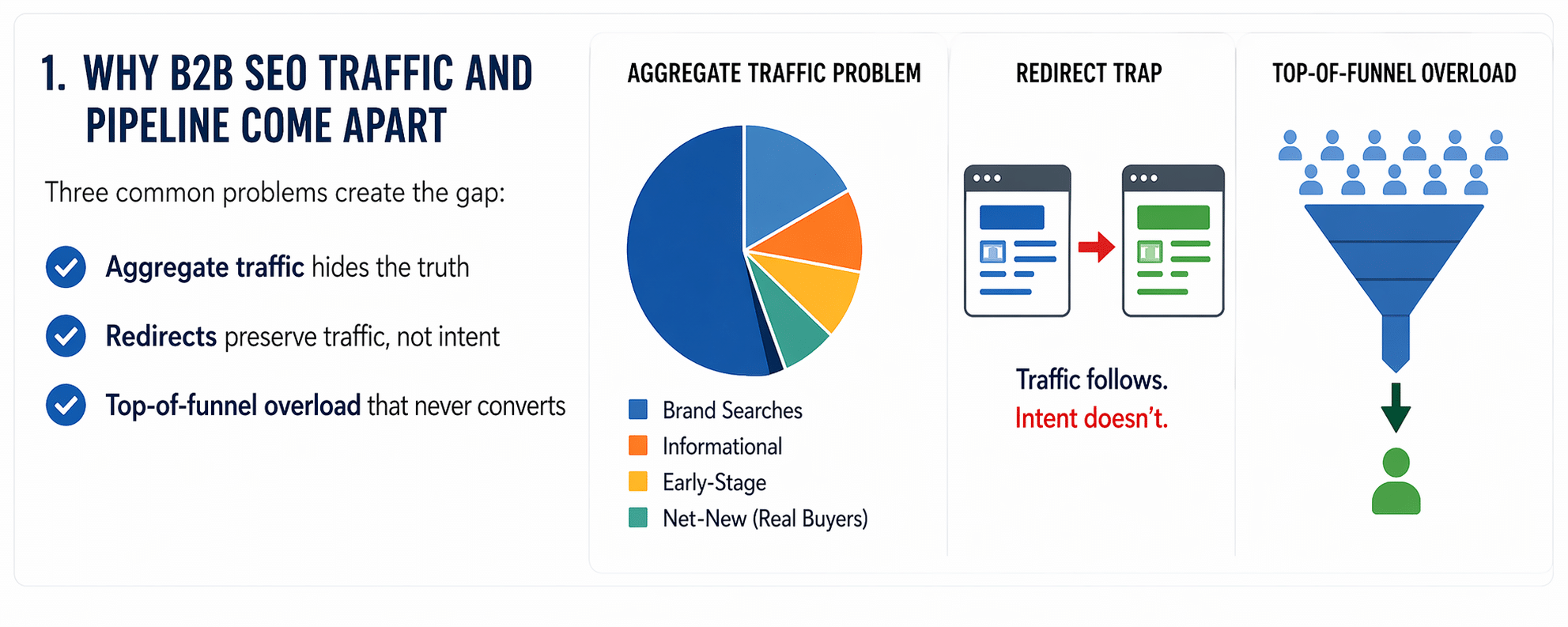
The problem is when teams stay there. Top-of-funnel content does not convert. It introduces. You establish the broad foundation and move into more specific, nuanced content as quickly as the authority will support it, because specific content is where intent sharpens and pipeline starts.
The Four Questions a B2B SEO Strategy Has to Answer
When I’m diagnosing a B2B SEO program, I run it against four questions in sequence. They’re not complicated. But skipping any of them is where the gap between traffic and pipeline opens up.
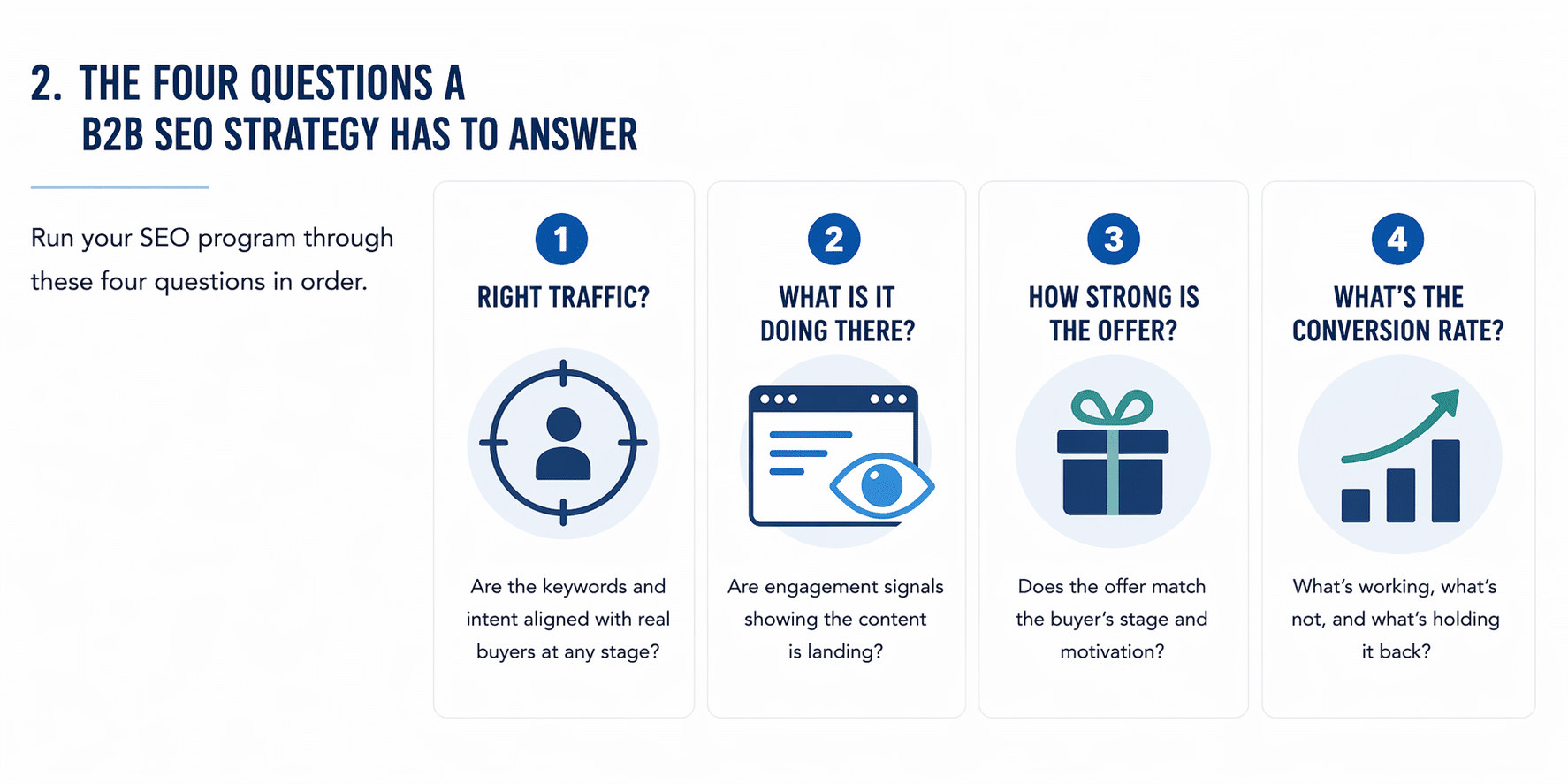
The first question is: Am I driving the right traffic? Not more traffic. The right traffic. This means looking at which pages are sending sessions, what keywords those pages rank for, and whether the intent behind those keywords maps to a buyer at any stage of a real purchasing decision. A post ranking for a high-volume informational term might be impressive to report on. If the people searching that term will never buy your product, it’s noise.
The second question is: What is that traffic doing when it gets there? Staying, scrolling, bouncing, reading. The behavioral signals in GA4 tell you whether the content is landing. High bounce rates on a conversion-oriented page are a signal. Low scroll depth on a long-form post is a signal. Time on page for a product-adjacent article that should be driving demo requests is a signal. These behaviors tell you whether the page is actually serving the visitor or just technically ranking.
The third question is: How strong is the offer? Once qualified traffic reaches the right page and the content earns their attention, something has to happen. A CTA to book a call. A content upgrade. A free tool. A demo. If the offer doesn’t match where the visitor is in their buying process, you’ll lose them. A visitor in early research mode who lands on a page that immediately asks for a 30-minute sales call will leave. A visitor comparing final options who finds a blog post with no conversion path will also leave, just with different data attached.
The fourth question is: What is the conversion rate of that offer, and what’s holding it back? This is where SEO work bleeds into CRO, and that’s intentional. Driving qualified traffic to a page with a weak offer is a waste of the SEO investment. You can read more about connecting organic search to conversion performance in my post on zero-click SEO, but the short version is that B2B pipeline attribution requires the full chain to work, not just the organic acquisition piece.
The Multi-Stakeholder Reality of B2B Buying
B2B purchases don’t have one searcher. A mid-market software deal might involve an end user who discovered the product through a how-to article, a team lead who ran a comparison search, a Director of Marketing who asked their EA to compile options, and a CFO who approved the budget. Each of those people is searching differently, at different times, with different questions.
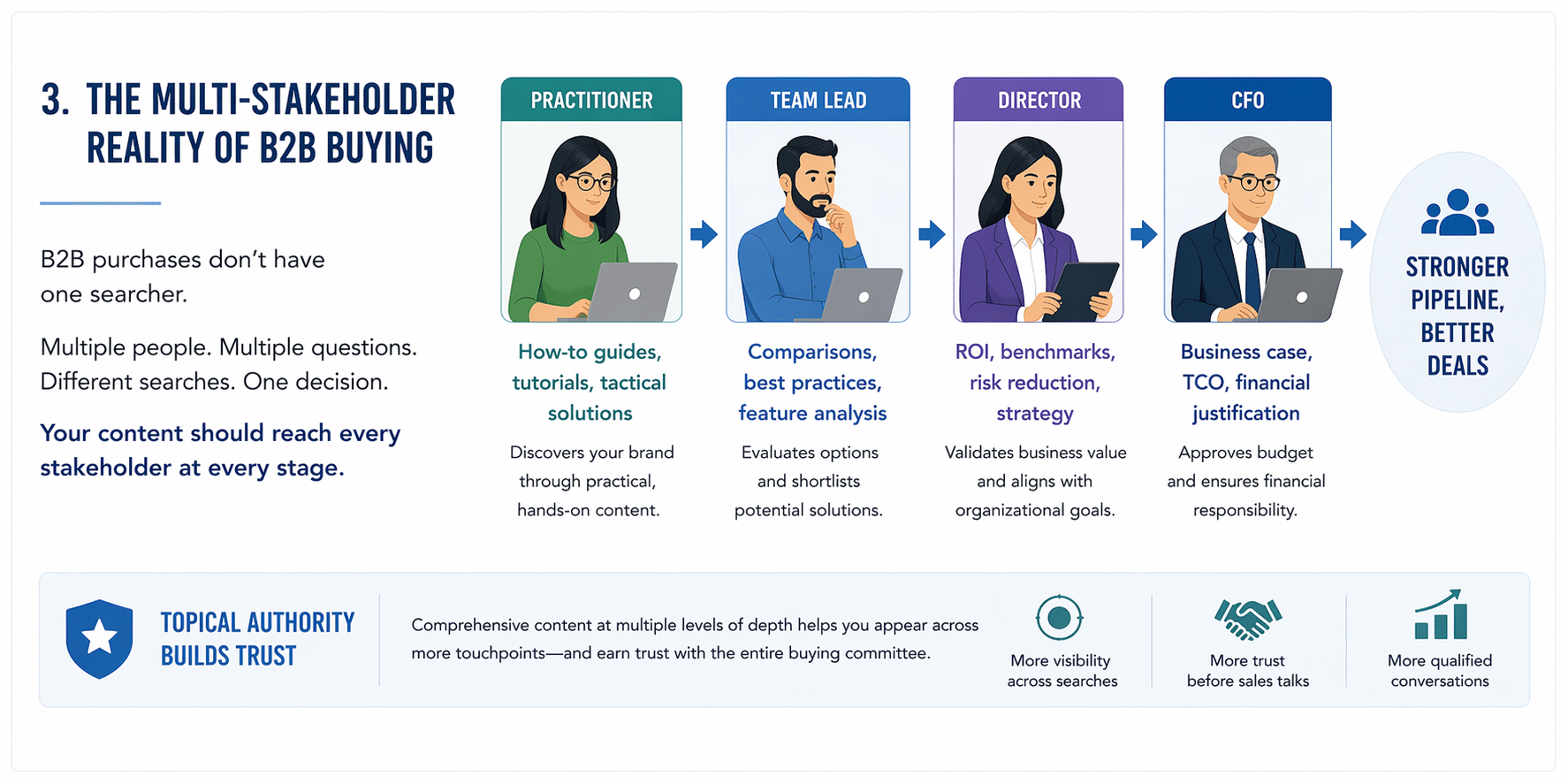
A B2B SEO strategy that only targets one of those people is leaving opportunity on the table. The practitioner-level content (how-to guides, tutorials, tactical frameworks) earns the attention of the people doing the work. The strategic-level content (ROI framing, risk reduction arguments, industry benchmarks) serves the people signing the checks. Building content that touches both layers doesn’t mean writing two versions of every post. It means mapping your content plan against the full buying circle, not just the most obvious searcher.
This is also where topical authority becomes a competitive moat. If your site comprehensively covers a topic area at multiple levels of depth and sophistication, you’re more likely to surface across multiple touchpoints in a buying cycle. The practitioner finds you through a tactical search. The Director finds you through a strategic one. By the time a sales conversation starts, the brand has already built trust with more than one person in the room. That does not happen with a content library built entirely around one keyword cluster at one level of intent.
Measuring SEO in the Zero-Click Era
The old measurement playbook for B2B SEO was built around clicks and sessions. That playbook is increasingly incomplete, and teams that don’t update it are making budget decisions on partial information.
Google AI Overviews now answer a growing portion of B2B queries directly in the SERP. When that happens, the user gets the information they needed without clicking through. The ranking position still exists. The impression still happened. The click did not. If you’re measuring SEO performance purely in GA4 sessions and organic channel conversions, you are systematically undercounting the value your content is generating. I covered this shift in detail in my post on the current state of SEO in 2026.
There are several places to look for a more accurate picture.
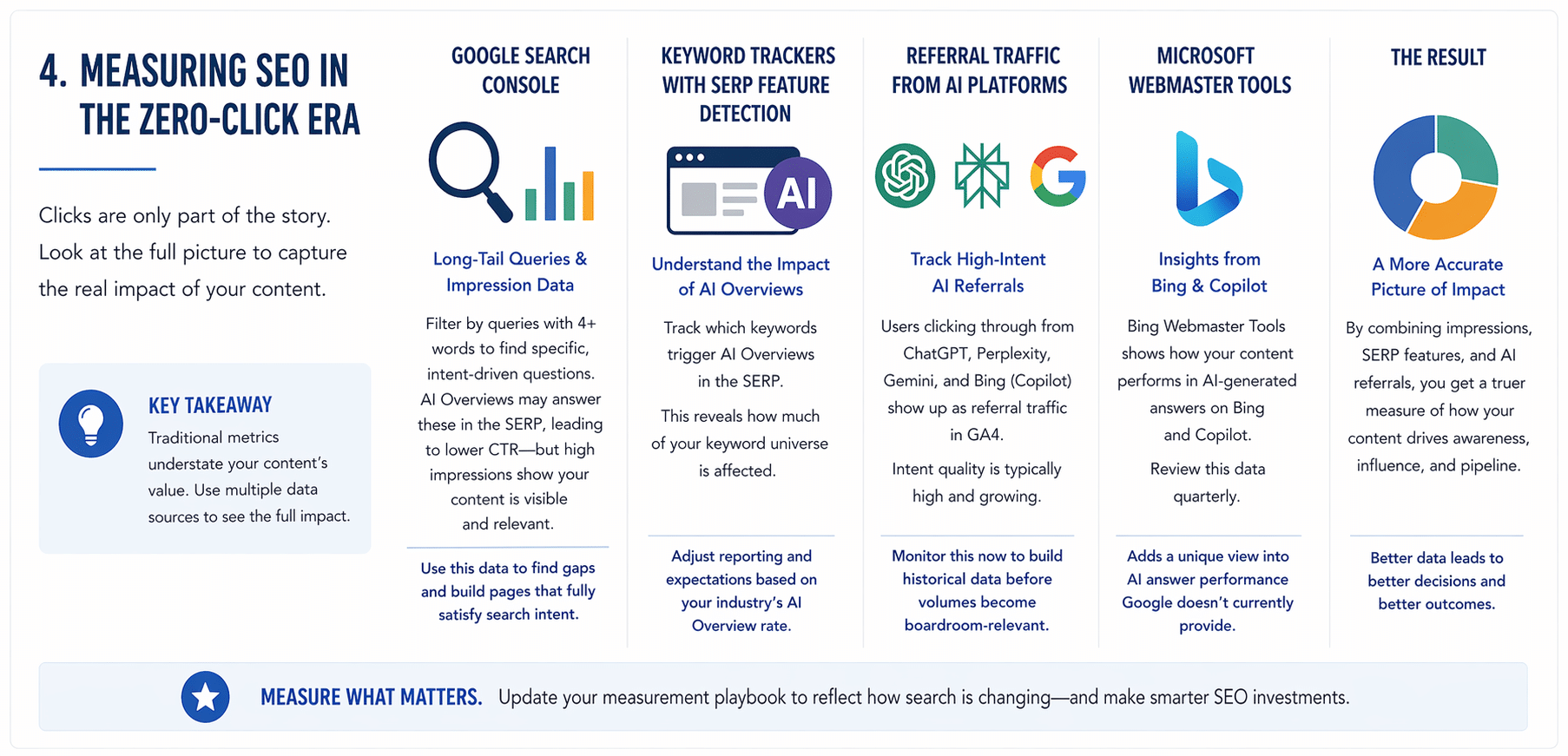
Google Search Console: Long-Tail Queries and Impression Data
Open Google Search Console and filter your queries by length. Search strings of four or more words are typically specific, intent-driven questions. Many of these trigger AI Overviews and receive low click-through rates not because the content failed, but because the answer was surfaced directly in the SERP. The impression data tells you the content was relevant and visible. The low CTR tells you the format of search is changing, not that the page is underperforming.
If you find a long-tail query where you rank in positions 4 through 15 with reasonable impression volume but low clicks, that’s a signal in both directions. It means the content is close to satisfying the query but not fully doing so. Build a more specific page around that exact query. That loop, find the gap, build the page, is the essence of compounding B2B SEO performance. It’s less exciting than publishing broad content. It converts at a higher rate than almost anything else.
Keyword Trackers with SERP Feature Detection
Most modern keyword tracking platforms now flag when a tracked keyword triggers an AI Overview in the SERP. Use that data to understand how much of your keyword universe is being affected. If 30% of your tracked keywords trigger an AI Overview, that tells you something meaningful about how to weight impressions versus clicks in your industry specifically. If it’s 5%, your traditional click-based metrics are still reasonably representative. The percentage varies significantly by category. In technical B2B software, it tends to be high. In regulated industries, lower. Knowing your number changes how you report and how you set expectations with leadership.
Referral Traffic from AI Platforms in GA4
This is one of the most underutilized signals in B2B SEO right now. When a user asks ChatGPT, Perplexity, Gemini, or another AI assistant a question and that assistant cites your site and the user clicks through, that traffic appears as referral traffic in GA4 with the platform as the source.
Go into GA4, open the traffic acquisition report, and filter by referral source for domains like chatgpt.com, perplexity.ai, gemini.google.com, and bing.com (which surfaces Copilot referrals). For most B2B brands, this number is still small. But it is growing, the rate of growth is meaningful, and the intent quality of AI-referred traffic tends to be high because the user was already in a research or decision-making conversation when they clicked. Tracking this now means you’ll have historical data when the volume becomes boardroom-relevant. You can read more about getting your brand cited by AI platforms in my post on whether you should optimize for AI search.
Microsoft Webmaster Tools for AI Overview Insights
Bing’s Webmaster Tools has added reporting features that surface how your content performs in AI-generated responses within Bing and Copilot. For established B2B brands with existing search presence, this is worth reviewing quarterly. It won’t replace Google Search Console as your primary data source, but it adds a signal that Google doesn’t currently provide directly, specifically how your content is being used in AI-generated answer contexts rather than just traditional organic rankings.
Building the Content That Actually Closes the Gap
The tactical loop that produces consistent B2B pipeline from SEO is not complicated, but it requires discipline to run consistently.
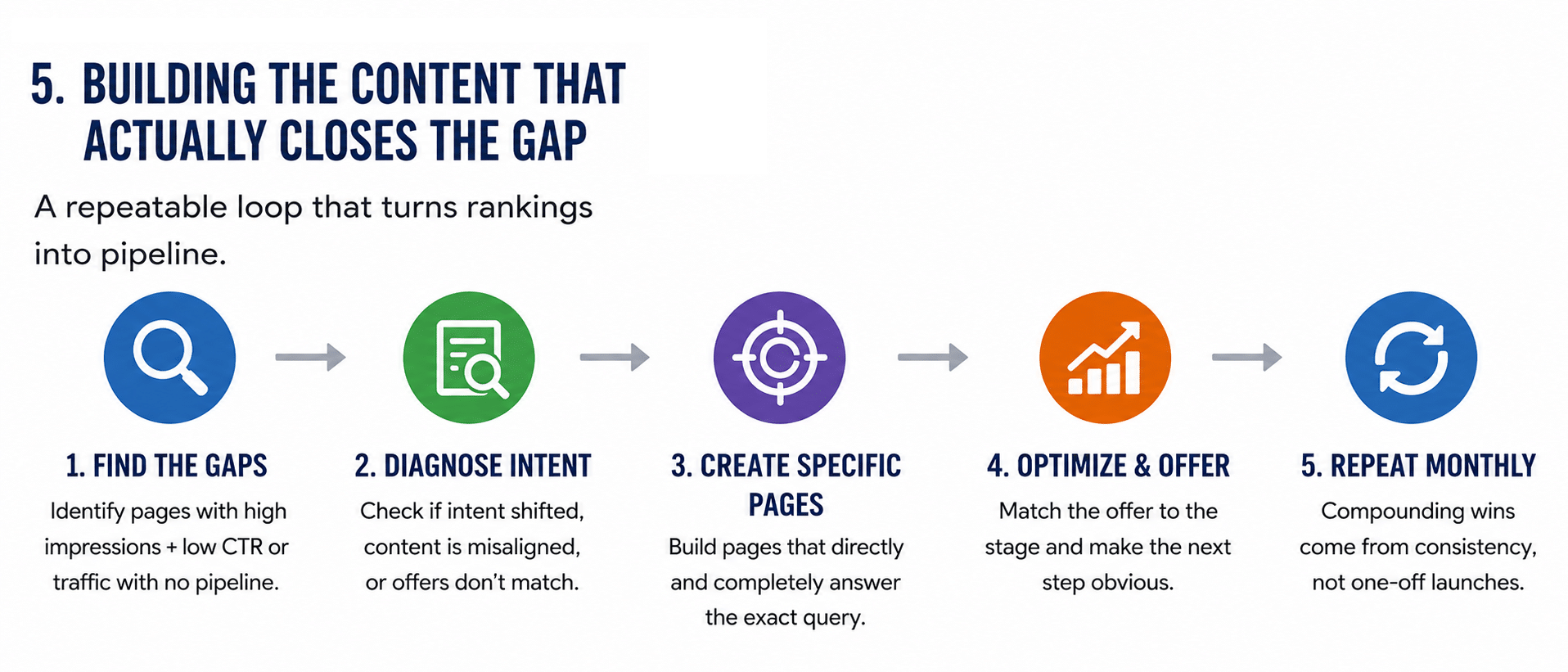
Start with your current rankings and identify pages that have meaningful impressions but low click-through rates, or pages that are attracting traffic but not generating any downstream pipeline activity. For the impression-heavy, low-CTR pages, investigate whether the query intent has shifted (using Google Search Console) or whether the content is being partially consumed via AI Overview (In search results).
For the traffic-but-no-pipeline pages, audit whether the offer and content match the intent of the traffic arriving. A good car salesman doesn’t immediately try to sell you the Porsche the moment you get to the lot, they learn more about your daily driving needs first. This same rule applies to your audience.
Then find the specific queries where you show up but don’t fully satisfy the search.
A position 12 ranking for a four-word B2B query with decent impression volume is a clear signal: you’re relevant, but not the best available answer. Build a page that is specifically designed around that query. Not a broader topic page that happens to mention it. A page where the title, the structure, and the first three paragraphs directly and completely answer what that searcher is looking for. That specificity is what earns both the ranking improvement and the higher conversion rate once the right visitor arrives.
Repeat that loop monthly. It produces less flashy output than a big content calendar launch. It compounds in a way that big content launches rarely do, because each page you build answers a real question a real buyer is asking, and a real buyer who finds a complete answer is closer to a conversation than one who finds a category overview. For a deeper look at how to structure your B2B content around the full buying funnel, my SaaS SEO strategy guide covers the three-layer intent framework in detail.
Where B2B SEO Actually Creates Pipeline
Pipeline comes from the right visitor finding the right content at the right moment and finding a reason to take the next step. SEO’s job is to put that content in front of that visitor. Everything else, the offer quality, the conversion path, the follow-up, belongs to the broader revenue system.
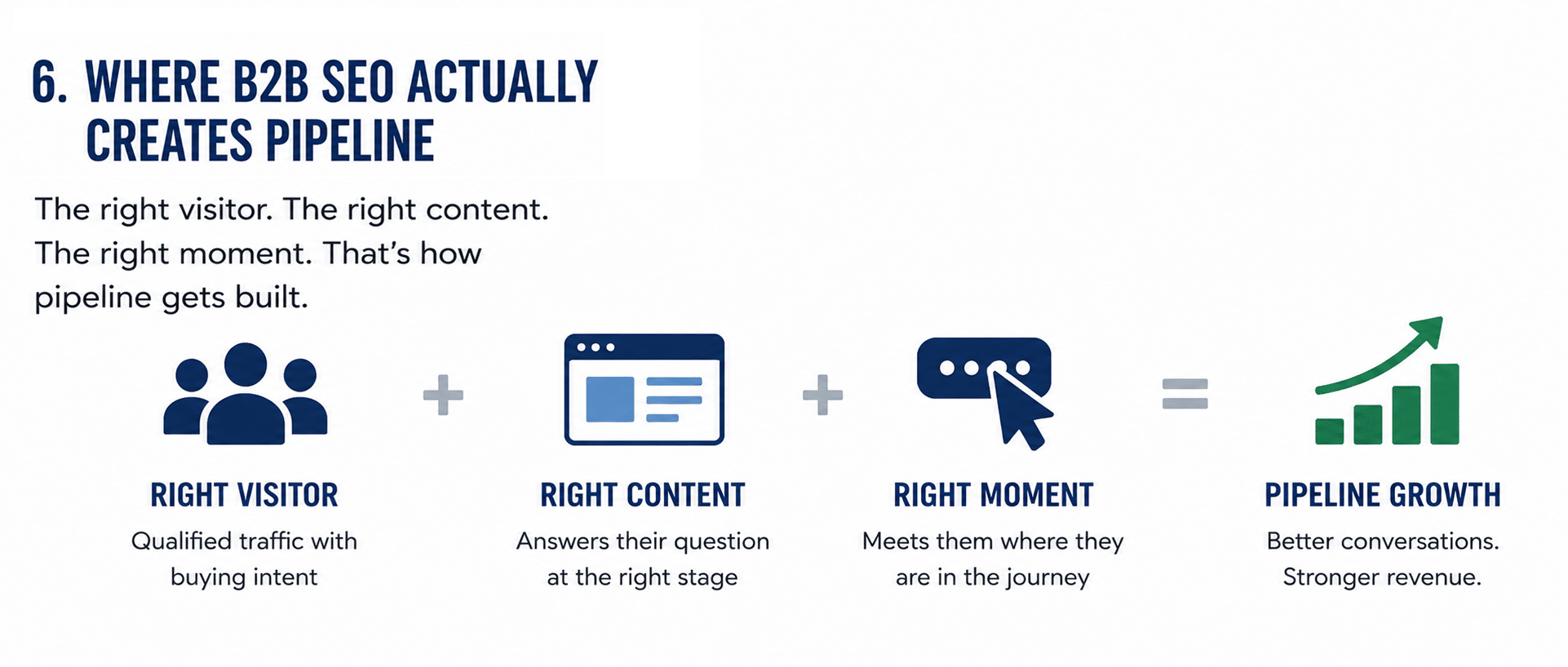
Where B2B SEO teams lose that chain is usually one of three places: driving the wrong traffic and calling it a win, ignoring how measurement has shifted in the AI search era and reporting incomplete numbers, or staying in the top-of-funnel content layer indefinitely and never building the specific, intent-matched content that actually closes the gap between someone researching and someone buying.
Fix those three things and the pipeline shows up. Not immediately, because organic search does not produce immediate results. But it shows up in a way that compounds, that doesn’t disappear when you cut the ad budget, and that produces better-qualified conversations than most other channels will.
If you want to pressure-test your B2B SEO strategy against the pipeline question, get in touch and we can work through it together.