
Every six months, there’s a new tactic the SEO industry decides is the thing. A new content format. A new schema type. A new “trick” to grab AI Overviews. And every six months, SaaS marketing teams chase it, execute it, see a short-term bump, and then watch it evaporate when Google updates its guidelines.
I’ve audited enough SaaS accounts to say this with confidence: the teams that struggle with organic search aren’t struggling because they missed the latest trend. They’re struggling because they abandoned the fundamentals to chase it.
SaaS SEO is a long game. What you plant today, you harvest 6, 12, sometimes 24 months from now. Getting the strategy right at the start is the difference between building a compounding organic pipeline that produces for years and spending your entire growth budget on paid acquisition with no floor.
This guide isn’t a boring ‘how-to’ about tactics, it is about the mindset that makes a SaaS business successful with SEO.
What Is SEO for SaaS?
SEO for SaaS is the practice of building organic search visibility for software products, with the goal of driving qualified pipeline rather than raw traffic volume.
It differs from traditional SEO in these meaningful ways:
- the buyer journey can be longer
- the intent signals are more nuanced
- retention strategies matter
- keywords that actually convert are often not the ones with the highest search volume.
A SaaS company selling project management software doesn’t just want to rank for “project management software.” They want to be found when a Director of Operations searches for why their team keeps missing deadlines, or when a Head of Engineering looks for how to run better sprint retrospectives. The product is the answer. The search query is the symptom. Understanding that gap is what separates a real SaaS SEO strategy from a keyword list.
The Trend-Chasing Trap
Here’s a pattern I see constantly. A new content tactic gains traction in the SEO community, the trade publications run with it, and within a few months every agency is pitching it as the cornerstone of their strategy. SaaS teams buy in, allocate budget, and produce dozens of pieces of content built around the format.

Then Google adjusts.
A good example of this played out with self-serving listicles. For a period, publishing “best [category] software” lists that conveniently featured your own product near the top was a widely-used tactic.
It worked, briefly. Then Google cracked down on exactly that type of self-promotional content that lacked genuine editorial independence.
Teams that had built their entire content strategy around it found themselves with a library of posts that either tanked in rankings or required significant rework.

The tactics that fail are almost always the ones optimized for the algorithm rather than the reader. The fundamentals that hold are the ones built for humans first. Time is money, and work that compounds pays back because at the end of the day your marketing needs to be able to convince a human to buy.
Audience Research: The Step Most SaaS Teams Skip Integrating Into SEO
Before you write a single piece of content or build a keyword list, you need to understand how your audience talks about the problem your product solves. Not how your founder or product team describes it. Not how your sales deck frames it. How the people with the problem actually describe it in the wild.
Audience Research Tools
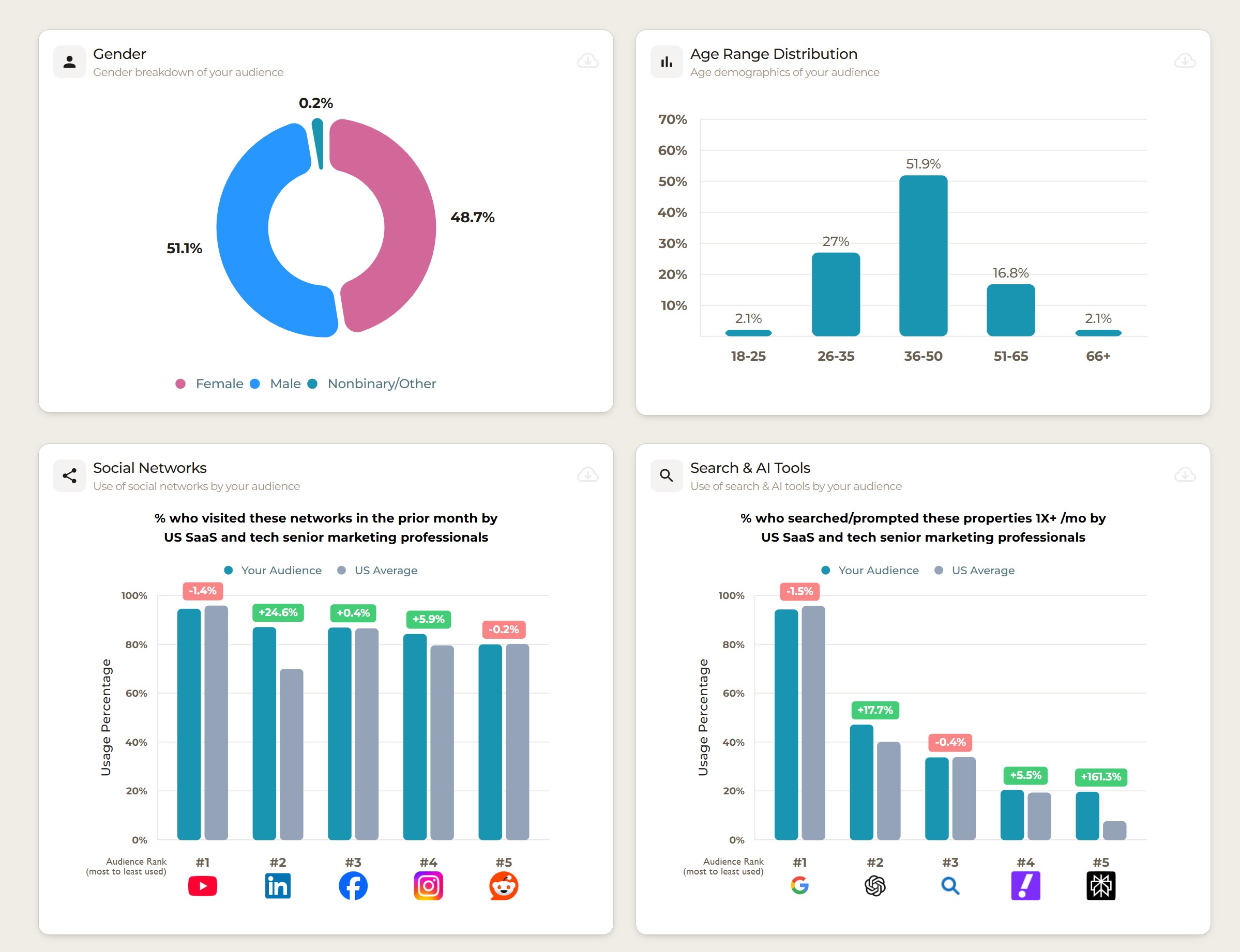
I use SparkToro for this. It surfaces where a target audience spends time online, what they read, what they watch, and the language that shows up repeatedly in how they describe their challenges. That data grounds your content strategy in observed reality instead of assumptions. You can do all sorts of varied search types to make reports you can use to guide you.
Reviews and User Generated Content (UGC)
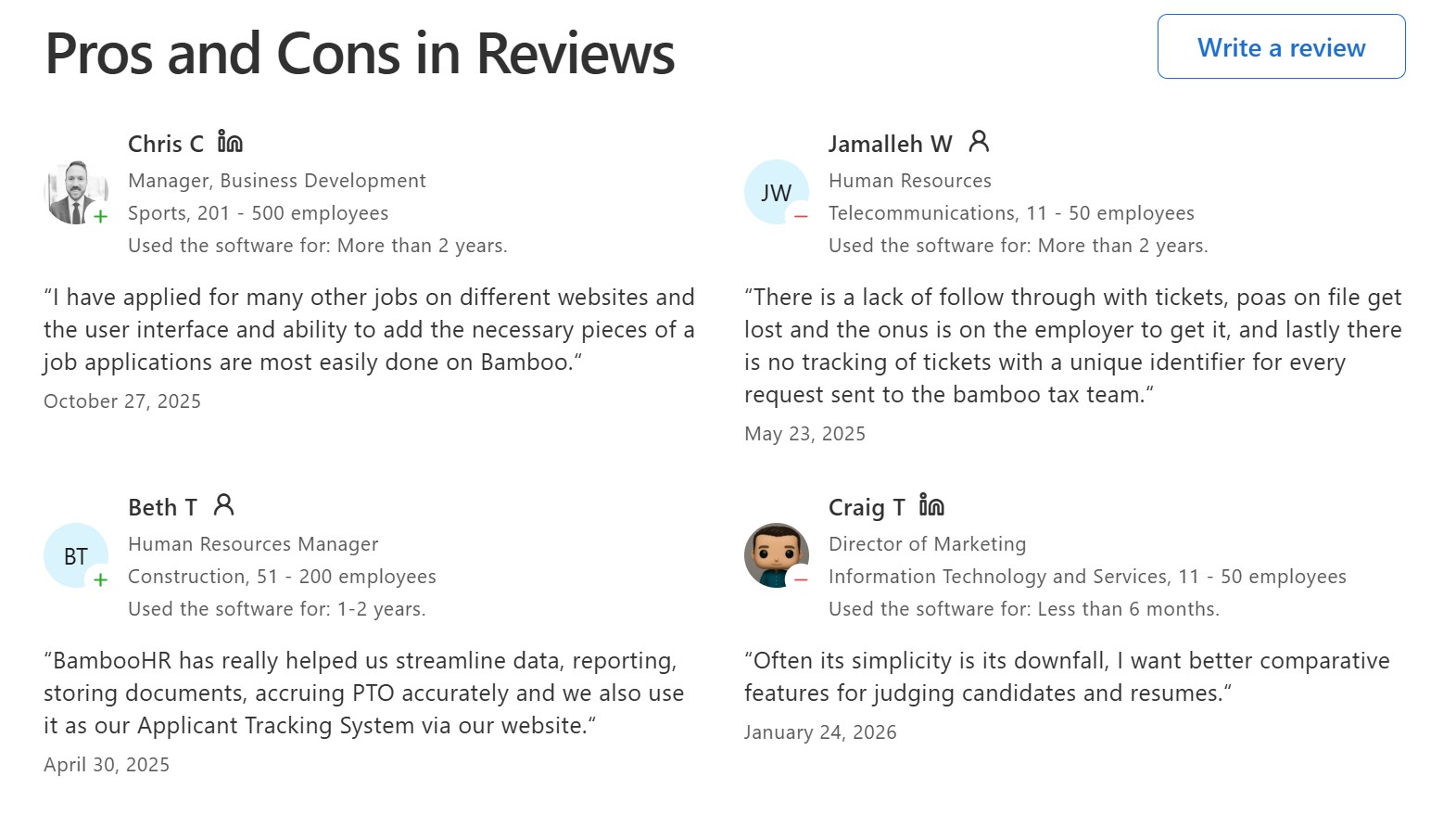
The other underused source is competitor reviews. If you pull your top three competitors on G2, Capterra, or Trustpilot and read the one-and-two-star reviews, you’ll find the exact language frustrated customers use to describe what’s broken. That’s your content goldmine. Those are the searches people run before they find your category.
User-Generated Reddit threads work the same way. Search for the problem your ICP is trying to solve, not the product category, and read how they frame it.
Of equal magnitude, positive reviews can be used to understand the things customers valued most that satisfied their needs and how they talk about it. Sometimes your product may only have adjacent competitors, but its good to start somewhere with the peers who live in circles that are near your buyer.
There’s also the good old fashion peer-to-peer approach through events and conventions. All the trade secrets start to flow during the after hours taco and margarita bar opening. Networking in adjacent spaces can be a powerful way to validate.
This all matters because it changes what you target. Most SaaS SEO strategies are built around the product category keyword: “best CRM,” “project management software,” “email marketing platform.” But a huge portion of high-intent traffic lives in the problem-aware layer, and those people often don’t yet know the category they’re looking for.
Use aggregate insights to fill in gaps and systematically categorize potential angles to pursue. If insights are limited, use adjacent categories and develop a plan for testing the market by leaning more into demand generation strategy. This means keywords become less about what you do, and more about solving utility problems.
Intent: Not What It Is, But What It Does
SaaS keyword strategy tends to overweight informational and navigational queries and underweight the transactional and problem-solving ones.
There’s a meaningful difference between someone searching “what is CRM software” and someone searching “how to stop losing leads between sales and marketing.”
The first person is learning. The second person has a problem and money to spend. Those queries vary in volume, in competition, and in how hard they are to capitalize on. The second type often converts at a much higher rate because the intent is commercial, even if the search phrasing doesn’t look like it.
When I build a keyword strategy for a SaaS client, I think in three buckets.
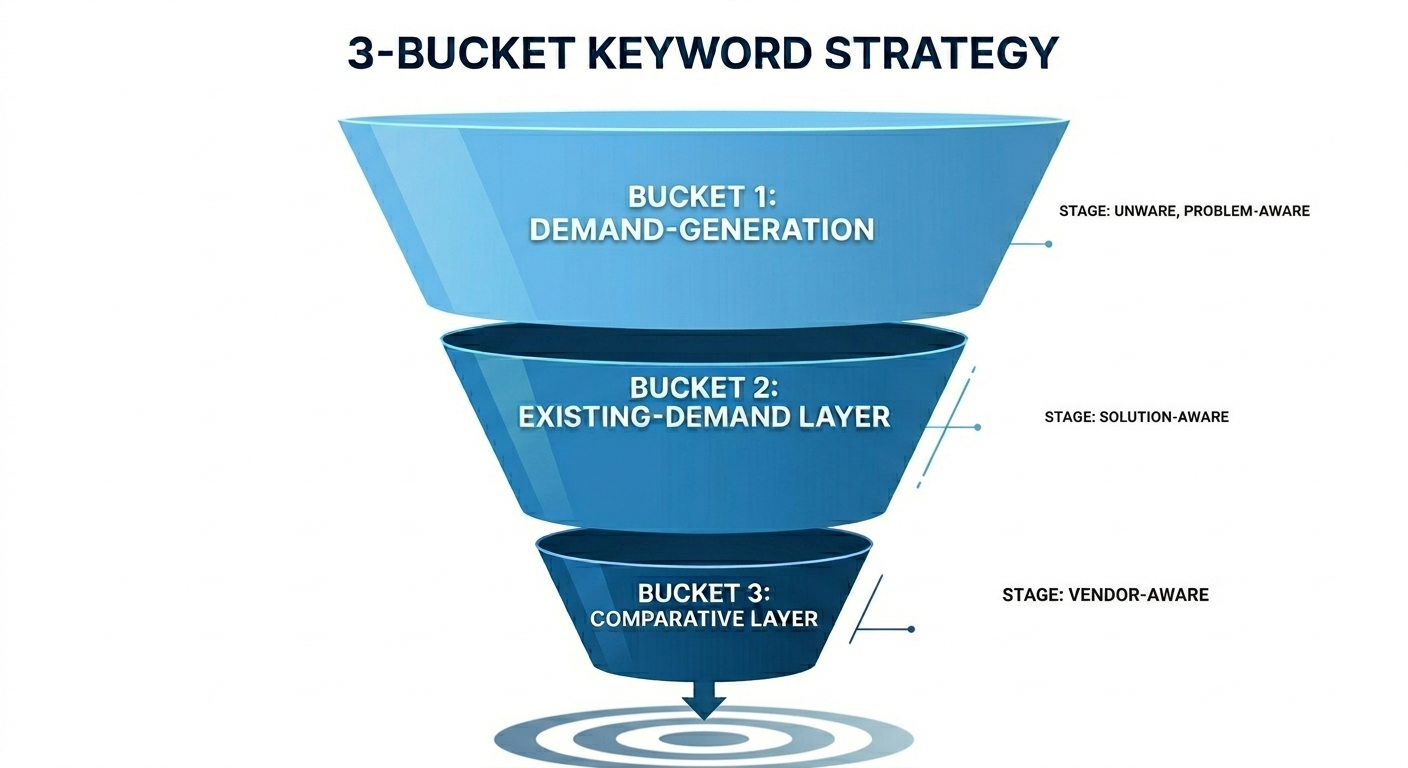
There’s the demand-generation layer, where we’re creating content for people who don’t yet know the solution exists.
There’s the existing-demand layer, where we’re capturing people already looking for something like what the product does.
And there’s the comparative layer, where people are actively evaluating options.
The mistake is building a content strategy that only addresses the middle bucket. The existing-demand searches are competitive, often dominated by review aggregators, and expensive to rank for. Going upstream to generate demand, and downstream to win comparisons, is where differentiated SaaS content actually earns its keep. You can learn more about how this dynamic plays out at the content strategy level in my post on the current state of SEO in 2026.
The Compounding Argument for Organic
Here’s the conversation I have with almost every SaaS team I work with: their paid acquisition is working, but the efficiency is declining. Cost per click is up, conversion rates are flat, and the board is asking uncomfortable questions about growth sustainability.
The problem with a growth model that’s 100% reliant on paid acquisition is that there is no floor. Turn off the ads, lose the leads. Raise prices on the platform, squeeze the margin. Every venture capital conversation, every acquirer diligence call, every investor update involves someone asking what percentage of revenue is organic. Nobody wants to hear “all of our pipeline comes from Google Ads.” That’s not a business. It’s a media buy.
Organic search compounds. A piece of content that ranks well in month six continues to earn traffic in month thirty-six without additional spend. An internal linking structure built thoughtfully over twelve months becomes increasingly hard for competitors to replicate. A topical authority position built through consistent, expert content creates a moat. Paid acquisition, while often necessary, builds nothing you own. SEO builds an asset.
The reason more SaaS teams don’t have this is because they want the results in Q2 that organic won’t deliver until Q4 of next year. So they default to paid, deprioritize organic, and then wonder two years later why they still have no floor.
What a Real SaaS SEO Strategy Actually Looks Like
It starts with audience research before keyword research. Before you open any SEO tool, you should understand the vocabulary of the problem.
SparkToro, competitor reviews, Reddit, industry forums: any source that shows you how your ICP talks about their pain. That language becomes your keyword seed list, not the other way around.
From there, you build a keyword strategy that spans all three intent layers: demand generation, existing demand, and comparative. You’re not trying to rank for everything. You’re trying to own the searches that map to the full buying journey of your ICP.
Then you build content that earns its position through genuine expertise. That means opinionated posts written at the level of your reader’s sophistication, not beginner explainers stuffed with your target keyword. It means making specific claims backed by evidence. It means being willing to say something the competition isn’t saying.
Technical SEO is the plumbing. You need it right: clean crawlability, fast load times, solid internal linking. But it’s the floor, not the strategy. I’ve seen plenty of technically pristine sites with no organic traffic because the content was thin and the topical authority was nonexistent. You can read more about building that technical foundation for AI search specifically in my post on how to get your site indexed by LLMs.
Measurement comes last in setup, but it needs to be in place before anything else goes live. If you can’t connect organic traffic to pipeline, you’ll never be able to defend the investment internally. Tracking should tie to revenue events, not just rankings.
The Mistake That Costs the Most
In my experience, the most expensive SEO mistake a SaaS team makes isn’t a technical error or a bad backlink profile. It’s starting a content program without a clear audience model, writing dozens of pieces based on keyword volume alone, and then wondering why traffic isn’t converting.
Good fundamentals take time to produce results, which is why teams get impatient and start chasing shortcuts. But the shortcuts don’t compound. The fundamentals do.
What you do in SEO today echoes into the next two years of your business. Teams that build their strategy on genuine audience insight, clear intent mapping, and consistent expert content build something that works harder over time. Teams that chase tactics build something they have to rebuild every six months.
If you’re evaluating your SaaS SEO approach and want a second opinion on whether your strategy has the right foundation, I’m happy to take a look.