
Most SEO fundamentals transfer. Keywords still matter. Technical accessibility still matters. Content that earns links still matters. The mistake is assuming that because the fundamentals travel, the playbook does too.
SaaS SEO is different from traditional SEO in a few specific, meaningful ways. The funnel doesn’t end at acquisition. The buyer isn’t always a single person. The content that matters isn’t always a blog post. And the product itself is often one of the best SEO assets a company has, sitting completely unexploited behind a login screen.
SaaS SEO differs from traditional SEO primarily in three ways:
- the conversion goal extends past the first click into trial activation and retention
- the buying cycle for anything above low-ticket pricing involves multiple stakeholders with different search behaviors
- the content formats that earn traction are broader than a standard blog-first approach
Getting those three things right requires a different strategic frame, not just a different keyword list.
Traditional SEO Ends at the Click. SaaS SEO Doesn’t.
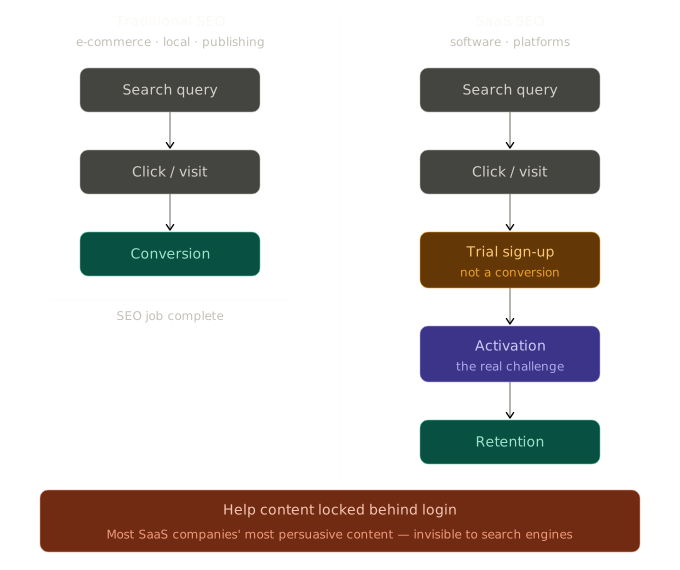
In e-commerce, local search, or publishing, the SEO job is largely done when someone clicks through. A product page sells the item. A local listing drives the visit. An article earns the pageview. The conversion happens close to the point of acquisition.
SaaS is different because the trial is a low bar, not a conversion. A free trial sign-up looks like a win in the acquisition data. In reality, it’s the beginning of the sales process, not the end. User retention is the number one challenge for most SaaS products, and a strategy that pours all its energy into getting someone to the trial start page and nothing into keeping them past day seven is a strategy with a hole in it.
I’ve audited SaaS accounts where the product documentation was genuinely excellent: detailed, well-organized, and completely invisible to search because it sat behind a login gate. The specific opportunity most SaaS companies miss is their own help content.
How-to documentation, onboarding guides, feature walkthroughs, use-case tutorials. This content answers exactly the kinds of searches that users run when they’re evaluating whether a product solves their problem, or trying to get value out of it after they’ve signed up. It’s high-intent, specific, and often has very low keyword competition because the question is product-adjacent rather than category-level.
Almost universally, this content lives behind a login or on a subdomain that hasn’t been set up to pass SEO value back to the main domain. The result is a company that ranks for broad category keywords while its most persuasive, specific content is invisible to search engines for their trial users to uncover. All the weight behind the customer experience then relies on your placement of the help buttons. Instead, opening that help content to public indexation, even partially, is often the highest-leverage SEO move a SaaS company can make with existing assets. It doesn’t require creating anything new. It requires making what already exists findable.
A good example of this is making documentation around support integrations your SaaS product supports available for users to uncover. Knowing it’s possible and that the process is readily available often skips the “is it possible?” step in the eyes of your buyer.
The Low-Ticket vs. High-Ticket Divide
How different SaaS SEO looks from traditional SEO also depends on where the product sits on the pricing spectrum, and the differences are significant enough to treat them as two separate strategic problems.
Low-Ticket Price SaaS
For low-ticket SaaS with a self-serve trial, the traditional acquisition playbook is tempting because it feels familiar. Drive traffic to the trial page. Optimize that page for conversion. Measure sign-ups.
The problem is the funnel assumption: that getting someone into the trial is the hard part. For many SaaS products, getting someone to try it is genuinely easy. Getting them to stay is not. A content strategy that only targets pre-trial searches leaves the post-trial user with nothing to find when they need help, and nothing to pull them back when engagement drops.
High-Ticket Price SaaS
For high-ticket or enterprise SaaS, the gap from traditional SEO is even wider.
I covered the multi-stakeholder dynamic in detail in my post on B2B SEO strategy, but the short version is this: the end user, the team lead, the Director, and the executive approving the budget are all running different searches at different stages of a buying process that can span months.
A traditional SEO playbook that targets one primary keyword for one primary audience misses most of that cycle. The content strategy has to map to multiple people, at multiple levels, asking different questions about the same purchase.
The Blog Is Not the Only Channel
Traditional SEO defaults to the blog as the primary content vehicle. Write the post, earn the ranking, collect the traffic. That model works. It just isn’t the complete picture for SaaS, and increasingly it isn’t the fastest path to early traction.
User signals are a real ranking factor. The Google search API leak in 2024 reinforced what most experienced practitioners already suspected: that engagement signals, how users interact with content after clicking, feed back into ranking decisions. For a new SaaS brand with a small content library and minimal authority, cultivating early user signals from real audiences matters more than producing raw content volume. Ten pieces of content that genuinely earn engagement outperform a hundred pieces that don’t.
That changes the medium calculation too.
Video & Audio SEO Matter More
Video content on YouTube earns engagement signals in a search engine that happens to be the second-largest in the world. A podcast or audio content builds audience in places your ICP already spends time. A guest article on a publication your buyers read every week reaches an existing audience with existing trust, without requiring you to build that trust from scratch.
None of these are substitutes for owned content, but for an early-stage SaaS brand trying to generate traction before domain authority builds, they can move faster than waiting for blog posts to rank.
Third-party platform presence deserves a mention here too.
Platform Review Sites Cultivate Brand Searches
Getting listed and reviewed on G2, Capterra, or similar category aggregators is a form of off-page SEO that most traditional playbooks don’t always include.
Those aggregator pages already rank for your category keywords. Appearing in them means your brand shows up in those results even before your own site earns a position. Getting these profiles doesn’t always earn links that count towards traditional SEO rankings. However, they do help bring brand awareness which cultivates brand searches.
You’ll sometimes hear this logic applied to what the industry calls “parasite SEO,” publishing content on high-authority third-party domains specifically to rank. I’m not an advocate for that approach. But the underlying idea of putting your brand where high-authority pages already rank is legitimate, and review aggregators are the cleaner version of that strategy.
These sites also position you at the forefront of buyer decisions by exposing your brand to them during the product comparison stages in their buyer journey.
It’s all about understanding how your buyer searches and makes decisions, then positioning yourself well in those spaces. Sometimes those are borrowed spaces like review sites and youtube, sometimes they are assets we create ourselves like blog posts and newsletters.
The Discipline Problem
One thing traditional SEO and SaaS SEO share is that neither produces results quickly. The difference is that SaaS companies, especially early-stage ones, operate at a pace that makes waiting for organic traction genuinely difficult. There’s pressure to show growth metrics quarterly, sometimes monthly. SEO works on a 6 to 12 month lag at minimum. Those two realities are in direct tension.
The teams that stick it out treat SEO as a parallel track to faster acquisition channels, not a replacement for them. Paid search drives near-term pipeline while organic builds. Content gets published consistently even when rankings haven’t moved. The strategy doesn’t get abandoned because month three didn’t produce month twelve results.
For a new SaaS brand, SEO works best as part of a broader growth plan rather than the sole acquisition mechanism. The organic channel builds an asset that compounds over time. Supplementary channels keep the business moving while that asset matures. Abandoning the strategy before domain authority has had time to build is how teams quit right before it would have started working. My SaaS SEO strategy guide covers the thought process behind the ‘compounding’ argument in full.
What Actually Changes
The fundamentals of good SEO don’t change because the product is software. Audience research still comes first. Technical accessibility still needs to be right. Content still has to earn its position through genuine usefulness.
What changes is where you apply those fundamentals. In SaaS, the help content is an SEO asset most teams leave indexed to nobody. The buying cycle has more people in it than the keyword research suggests. The content that earns early traction may live on YouTube or a third-party publication before it lives on your blog. And the strategy requires enough organizational patience to let organic search do what it does, which is compound slowly and then produce results that paid acquisition never will.
If you want to pressure-test where your SaaS SEO strategy diverges from what would actually work for your product, reach out and we can take a look together.